The 1897 Quarter Value Guide: What Your Barber Quarter Is Really Worth

A gem MS66 example sold at Stack's Bowers for $16,450 — yet most worn examples trade near silver melt. The difference comes down to mint mark, condition, and knowing which varieties matter. Use the free tools below to find out exactly where your coin stands.

★★★★★  4.8/5 · Trusted by 1,247 collectors
Check My 1897 Quarter Value →
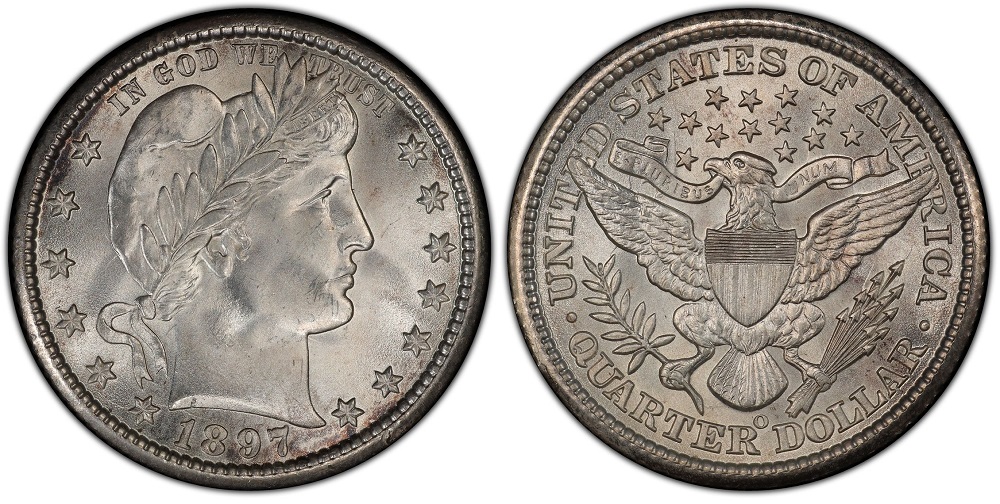
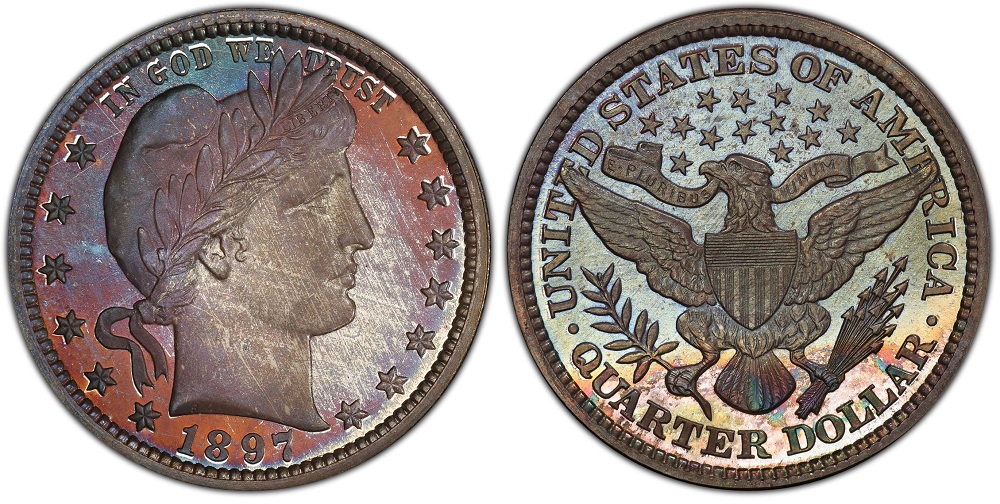
1897 Barber Quarter obverse and reverse showing Liberty head and heraldic eagle
$16,450 Top Auction Record (MS66 CAC, Stack's Bowers 2013)
542,229 Lowest 1897 Mintage (San Francisco — the scarce S-mint)
90% Silver Content — real melt value floor on every example
731 Proof Coins Struck — Philadelphia, for collectors only

1897 Barber Quarter Value Chart at a Glance

The table below summarizes current collector values across all three 1897 mint issues plus the proof, from heavily worn to gem uncirculated. For a thorough step-by-step 1897 quarter identification walkthrough covering every diagnostic feature, refer to the detailed 1897 Barber Quarter reference guide. Prices reflect realized auction data and dealer pricing — always verify against the current silver spot price.

Variety Worn (G–VG) Circulated (F–VF) Uncirculated (MS-60) Gem (MS-65+)
1897 Philadelphia (No MM) $25 – $35 $40 – $100 $200 – $400 $1,000 – $2,500+
1897-O New Orleans $30 – $50 $60 – $150 $300 – $600 $1,500 – $4,000+
1897-S San Francisco ★ $50 – $100 $150 – $400 $800 – $2,000 $4,000 – $12,000+
1897 Proof (Philadelphia) $400 – $800 $800 – $1,200 (PR-60) $2,500 – $5,000+ (PR-65)

★ Signature variety — highlighted. Proof row spans PR-60 through PR-66+; values scale significantly with Cameo and Deep Cameo designation. All values approximate; verify against current PCGS/NGC Price Guide.

📱 CoinHix lets you photograph your 1897 quarter and get an instant condition estimate right from your phone — a coin identifier and value app.

Quick Navigation

Jump to any section:

The Valuable 1897 Barber Quarter Errors & Varieties (Complete Guide)

Beyond mint mark differences, the 1897 Barber Quarter series has a handful of documented die varieties and production anomalies that attract a dedicated specialist following. The varieties below — ranging from repunched mint marks to the low-mintage proof issue — are ranked by collector demand and premium potential. Study each card carefully before dismissing your coin as common.

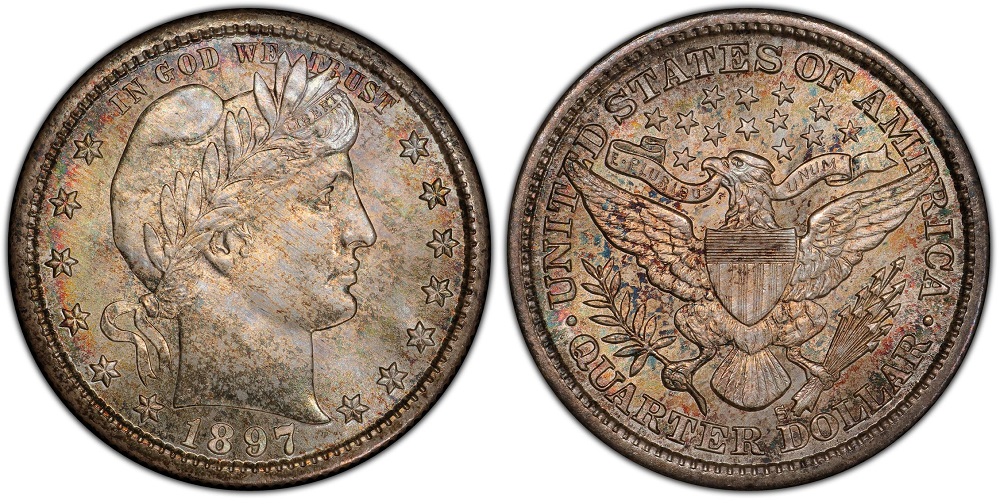
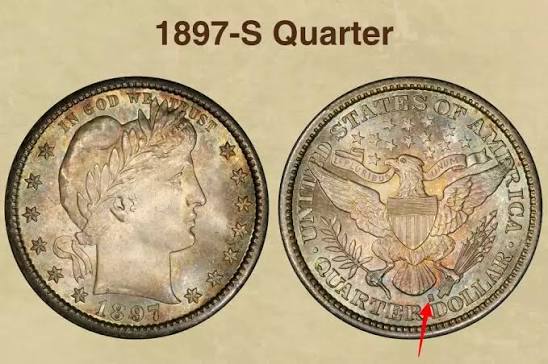
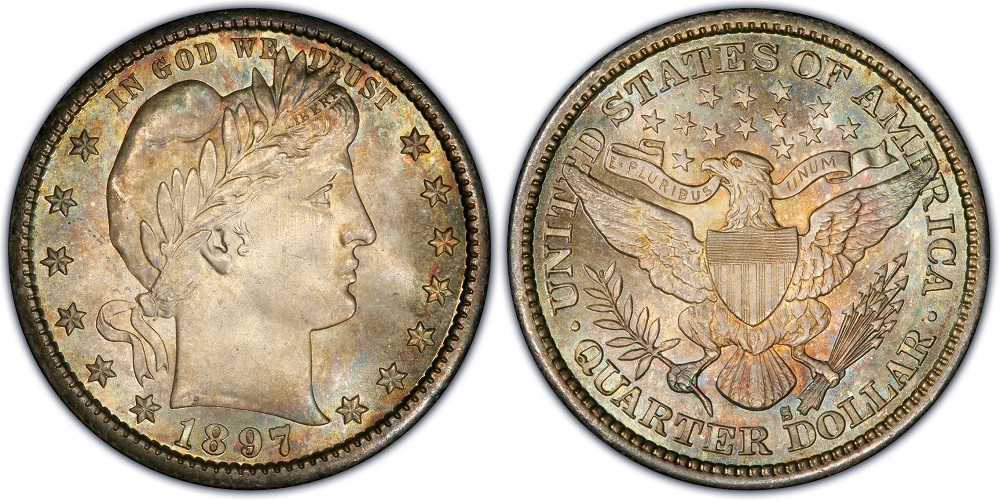
1897-S Barber Quarter reverse close-up showing S mint mark beneath eagle

1897-S San Francisco — Lowest-Mintage Business Strike

MOST FAMOUS $50 – $12,000+

The 1897-S Barber Quarter was struck at the San Francisco Mint with a business-strike mintage of only 542,229 pieces — making it the fifth-lowest mintage of any San Francisco Barber quarter in the entire 1892–1916 series. That relatively modest output, combined with decades of heavy circulation in the American West, means survivors in any condition above Good are genuinely scarce on the open market today.

Visually, the coin is distinguished from its Philadelphia and New Orleans siblings by the small "S" mint mark punched into the reverse die below the eagle's tail feathers, directly above "QUARTER DOLLAR." Under a 5× loupe, the S should be clean and centered; off-center or repunched examples exist and carry a specialist premium. Strike quality from San Francisco in 1897 was generally better than New Orleans, so the eagle's claws and Liberty's hair tend to show sharper definition on well-preserved examples.

Collectors pay a persistent premium for the 1897-S at every grade level because it anchors many a type-set collector's 1897 row and is a necessary coin for any complete Barber quarter set. In Mint State grades, the 1897-S is a genuine condition rarity — few original rolls survived — driving gem examples into four-figure territory. The survival rate across all grades is estimated at approximately 0.37%, implying roughly 2,000 examples remain in all conditions combined.

How to spot it

Flip to the reverse and look for a small "S" beneath the eagle's tail feathers above "QUARTER DOLLAR." Use a 10× loupe to verify the letter form; confirm the coin weighs 6.25g and is 24.3mm — authentication basics for any high-value Barber quarter.

Mint mark

S (San Francisco) — reverse, below eagle's tail, above denomination.

Notable

Survival rate estimated at ~0.37% of original mintage per CoinValueChecker data. Gem MS specimens regularly exceed $4,000 at major auction houses. A centered mintmark example noted by Coinfully as a specialist premium piece; check population reports at PCGS before buying.

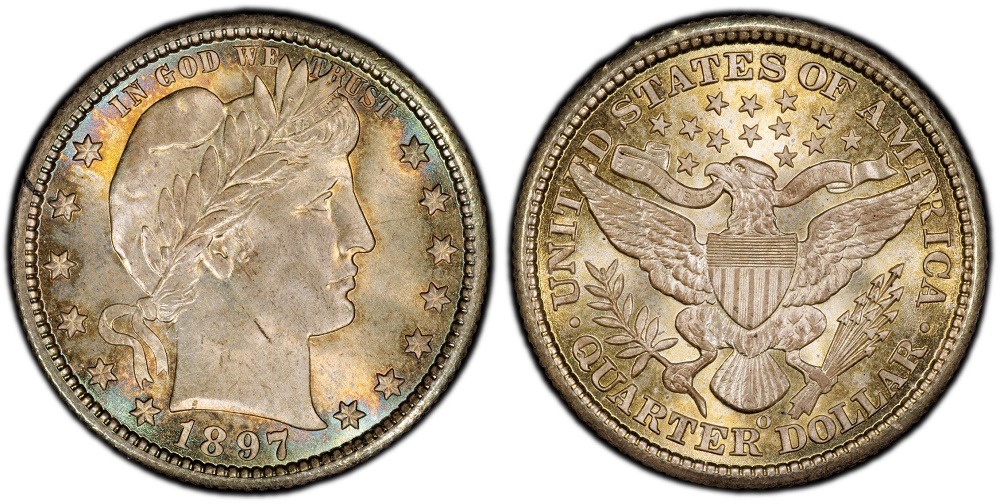
1897-O Barber Quarter reverse detail showing O mint mark and eagle with New Orleans strike characteristics

1897-O New Orleans — Condition Rarity & Soft-Strike Variety

RAREST IN HIGH GRADE $30 – $4,000+

The 1897-O Barber Quarter was produced at the New Orleans Mint with a mintage of approximately 1,414,800 coins. While numerically more common than the 1897-S, the New Orleans issue presents a specific challenge that makes uncirculated examples genuine rarities: the coin is frequently softly struck, particularly on the eagle's left (viewer's right) claw on the reverse. This strike weakness — documented by the ANA Grading Standards — is endemic to most New Orleans and Denver Barber quarter issues and can be mistaken for wear by inexperienced graders.

When examining an 1897-O, look at the eagle's claw area under a loupe. On a sharply struck example, individual talon tips should be distinct and well-separated. Softly struck pieces show blended, mushy claw detail even when the coin has never circulated. This distinction is critical: a well-struck 1897-O in AU or better grades commands a substantial premium over a typical soft-strike example of the same numerical grade.

The "O" mint mark appears on the reverse beneath the eagle, in the same position as the "S." Because the New Orleans survival rate has been estimated at approximately 0.14% of original mintage — below even the 1897-S rate — high-grade New Orleans examples are fewer in number than the raw mintage difference would suggest. Any 1897-O grading VF-30 or better deserves careful attribution before sale.

How to spot it

Find the "O" mint mark beneath the eagle's tail on the reverse. Then examine the eagle's left (viewer's right) claw under 10× magnification: sharply defined talons indicate a better-than-average strike and can significantly raise collector value versus a blurred claw.

Mint mark

O (New Orleans) — reverse, below eagle's tail, above denomination.

Notable

Survival rate ~0.14% of original mintage per CoinValueChecker. NGC's Coin Explorer documents that New Orleans issues are conditionally scarce in MS grades. The ANA Grading Standards specifically call out soft-strike issues at this mint. Sharp-strike AU-58 examples can trade at MS-62 pricing.

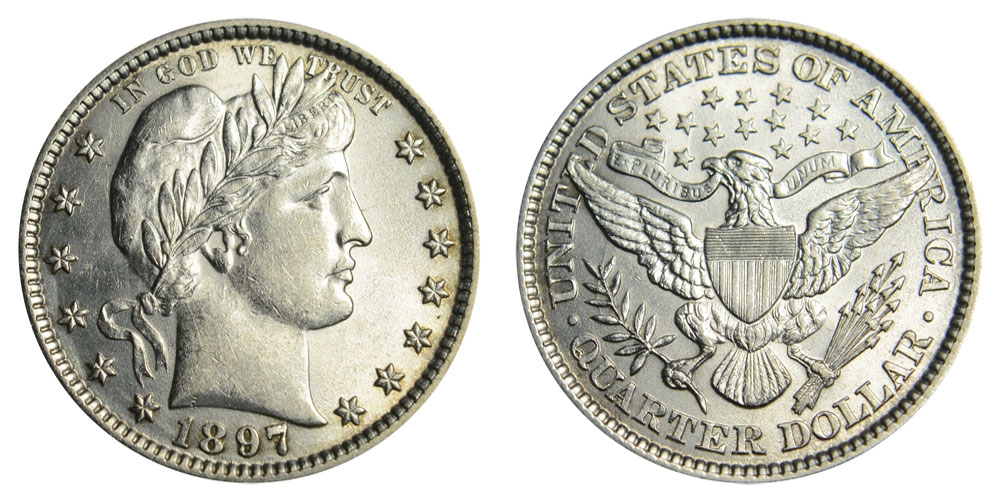
1897 Philadelphia Barber Quarter in gem mint state condition showing full cartwheel luster

1897 Philadelphia — High-Grade Gem Condition Treasure

MOST VALUABLE $25 – $16,450

The 1897 Philadelphia Barber Quarter had the largest mintage of the three 1897 issues at approximately 8,140,000 coins, and no mint mark appears on the reverse — Philadelphia coins were the only Barber quarters to omit the mint mark entirely. In worn and circulated grades, these coins are the most affordable of the 1897 trio, trading close to silver melt in the lowest grades. The real story begins in the Mint State range, where gem examples become legitimately scarce and highly sought after.

The auction record for the series is held by a Philadelphia example: a NGC MS66 CAC coin that realized $16,450 at Stack's Bowers in February 2013. This result underscores that even the high-mintage Philadelphia issue becomes exceptional in gem grades. The CAC (Certified Acceptance Corporation) sticker on that coin indicates it was approved as a premium-quality example within its assigned grade — a meaningful distinction for top-tier Barber quarters. Cartwheel luster, sharp strike, and original silvery-white surfaces are the hallmarks to look for.

PCGS CoinFacts confirms MS67+ as the finest known designation for the 1897 Philadelphia issue, with only a handful of examples known in that stratospheric tier. The grade rarity curve for this date is steep: MS-64 examples are obtainable in the low hundreds, MS-65 pieces quickly push into four figures, and MS-66 examples command strong five-figure bids at major auctions.

How to spot it

Look for the absence of a mint mark on the reverse below the eagle — confirms Philadelphia origin. Then tilt the coin under a single point light and look for unbroken cartwheel luster across both fields. Any gray, flat patch signals wear and drops the coin below MS-60 territory immediately.

Mint mark

None (Philadelphia Mint) — no letter appears on the reverse beneath the eagle.

Notable

Top auction record: $16,450 for NGC MS66 CAC at Stack's Bowers, February 2013 (PCGS CoinFacts #5616). Finest known is PCGS MS67+. CAC designation adds meaningful premium at MS-65 and above. Check PCGS/NGC population reports before buying any MS-65+ example to avoid overpaying for the grade.

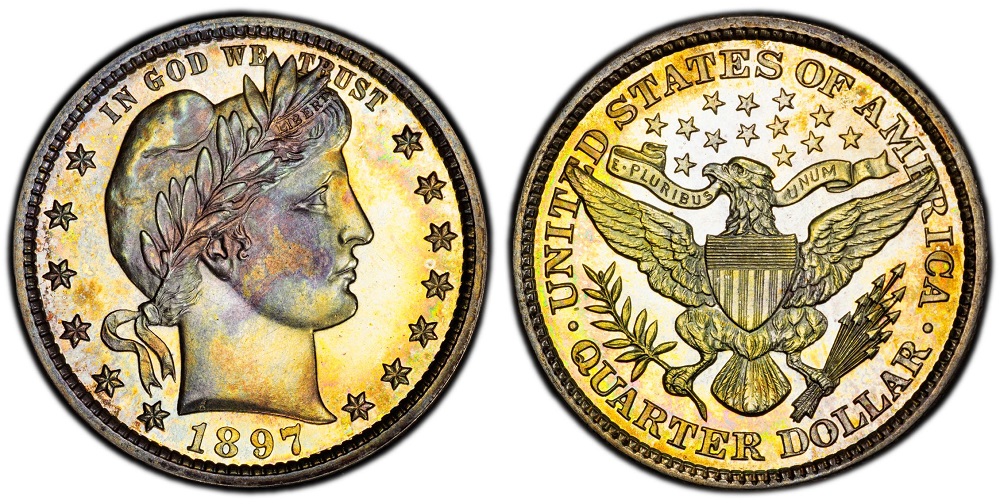
1897 Proof Barber Quarter showing mirrored fields and cameo contrast on Liberty head

1897 Proof — Philadelphia Collector Issue (731 Struck)

BEST KEPT SECRET $400 – $5,000+

In addition to the three business-strike issues, the Philadelphia Mint struck a small number of proof Barber Quarters in 1897 specifically for sale to collectors. With only 731 proof coins produced — and an estimated 650 surviving today based on their careful preservation — the 1897 Proof is technically rarer by survival count than any of the three business strikes, yet it is often overlooked because it is seldom seen in general circulation collections. Proof coins were sold directly to collectors at a premium price and never entered commerce.

Proof Barber Quarters are distinguished by their deeply mirrored (mirror-like) fields and frosted design devices — particularly Liberty's portrait and the reverse eagle — creating the cameo or deep cameo contrast that collectors prize. The 1897 proof was struck on specially prepared planchets using highly polished dies that were pressed multiple times at slow speed to bring up maximum detail. Hairlines from careless cleaning are the most common problem on proof Barber quarters, making problem-free examples especially desirable.

Value is driven primarily by the cameo designation: a straight PR-65 example trades for roughly $1,200–$1,800, while a PR-65 Cameo can reach $2,500–$3,500 and a Deep Cameo specimen at that grade level commands the highest premiums. CoinValueChecker notes that Deep Cameo proof examples are among the most expensive 1897 issues at any equivalent grade level. The near-90% survival rate means most proofs exist somewhere — the challenge is finding problem-free examples.

How to spot it

Look for mirror-like (reflective) fields on both sides combined with frosted, satiny design devices. Tilt the coin under a point light — proof fields show a perfect glass reflection. Use a 10× loupe to check for hairline scratches from cleaning, the most common problem that triggers a PCGS/NGC "Details" designation.

Mint mark

None (Philadelphia Mint only) — all 1897 proof Barber Quarters were struck exclusively at Philadelphia.

Notable

Only 731 struck; estimated ~650 survivors with a ~89% survival rate (CoinValueChecker). Cameo and Deep Cameo designations by PCGS/NGC substantially increase value. USA Coin Book quotes proof coins at $801+. Deep Cameo PR-66 examples have brought several thousand dollars at major auction houses.

Think you've spotted one of these on your coin?
Run it through the free value calculator and get an instant estimate.
Calculate My Value →

1897 Barber Quarter Mintage & Survival Data

Group of 1897 Barber Quarters from Philadelphia, New Orleans and San Francisco mints displayed together

The three 1897 business strikes represent a wide spectrum of production volumes — from the large Philadelphia issue to the scarce San Francisco output. Survival rates vary significantly and do not simply track mintage figures, meaning even the more common Philadelphia coin becomes rare in top grades.

Mint / Issue Mint Mark Mintage Est. Survival Rate Notes
Philadelphia None 8,140,000 ~0.15% Most common; gem grades very scarce
New Orleans O 1,414,800 ~0.14% Soft-strike issues; condition rarity in MS
San Francisco S 542,229 ~0.37% Lowest business-strike mintage; semi-key date
Philadelphia Proof None 731 ~89% Collector issue only; mirror fields
Total (all issues) ~10,097,760
Composition specs: 90% Silver, 10% Copper · Weight: 6.25 grams · Diameter: 24.3 mm · Edge: Reeded · Designer: Charles E. Barber · Series: Barber (Liberty Head) Quarters 1892–1916 · Silver content: 0.18084 troy oz per coin

How to Grade Your 1897 Barber Quarter

1897 Barber Quarter grading strip showing four condition tiers from worn Good to gem Mint State

The primary grading diagnostic for all Barber Quarters is the word LIBERTY inscribed on the raised headband across Liberty's forehead. Because the headband sits at the highest relief point on the obverse, it receives wear first and most severely. Reading the LIBERTY letters tells you the grade before anything else.

Worn (Good G-4 / VG-8)

LIBERTY is completely gone (G-4) or has at least three letters visible (VG-8). Liberty's portrait is reduced to an outline. Date and major design elements still present. Rim full but flat.

$25 – $100 (P) · $50 – $120 (O) · $60 – $150 (S)

Circulated (Fine F-12 / VF-20)

All seven LIBERTY letters visible at F-12, though may be weak. At VF-20, LIBERTY is sharp and Liberty's hair shows partial detail above the forehead. Eagle's feathers show moderate definition.

$40 – $100 (P) · $60 – $150 (O) · $150 – $400 (S)

Uncirculated (MS-60 to MS-63)

No wear anywhere. Mint luster present but may be broken by bag marks or contact marks (MS-60/61). MS-63 shows moderate contact marks but strong luster. Full sharp strike on both sides.

$200 – $400 (P) · $300 – $600 (O) · $800 – $2,000 (S)

Gem (MS-64 to MS-66+)

Full unbroken cartwheel luster, minimal contact marks, razor-sharp strike on Liberty's hair and eagle feathers. MS-66+ Philadelphia coins represent the pinnacle — the Stack's Bowers $16,450 record holder was MS66 CAC.

$500 – $16,450+ (P) · $1,500 – $4,000+ (O) · $4,000 – $12,000+ (S)
Pro Tip — Strike & Color Designation: Unlike copper coins, Barber Quarters are not designated by color. However, the "CAC" (Certified Acceptance Corporation) sticker is highly meaningful on MS-64 and above — it confirms the coin is a premium example within its assigned grade. For New Orleans issues specifically, look for sharp eagle claw detail before accepting a high-grade attribution; soft-strike pieces from the New Orleans Mint can masquerade as higher grades to the inexperienced eye, per NGC's official grading guide. Original silver-gray toning is always preferable to cleaned or bright-white artificial surfaces.

🔎 CoinHix can cross-check your coin's described condition against similar graded examples in its database — a coin identifier and value app.

1897-S Barber Quarter Self-Checker

The 1897-S is the most valuable and most searched 1897 quarter variety. Use this visual comparison and checklist to determine whether your coin is the genuine San Francisco issue — and whether it's worth a premium above a typical circulated example.

Side-by-side comparison of 1897 Philadelphia quarter (no mint mark) versus 1897-S quarter (S mint mark visible) on reverse

🔵 Common 1897 Philadelphia

  • No letter beneath eagle's tail
  • Higher mintage (8.14 million)
  • Worn example worth $25–$35
  • Gem grades still rare but more available

🌟 Scarce 1897-S San Francisco

  • Small "S" beneath eagle's tail
  • Low mintage — only 542,229
  • Worn example worth $50–$100
  • Gem MS grades: $4,000–$12,000+

Check all that apply to your coin:

Got a result? Now check what it's worth.

The self-checker tells you what variety you have — the calculator below converts that into a dollar estimate based on condition and known auction data.

Get My Value Estimate →

Free 1897 Quarter Value Calculator

Select your coin's mint mark, condition, and any known varieties to get an instant estimated value range based on current market data.

Step 1 — Select Mint Mark
Step 2 — Select Condition
Step 3 — Any Known Varieties? (Check all that apply)

If you're not yet sure of your coin's mint mark or condition, there's a 1897 Quarter Coin Value Checker online tool that accepts coin photos and provides an automated assessment — useful before committing to a grade.

Describe Your 1897 Barber Quarter for a Detailed Assessment

Tell us what you see — mint mark location, LIBERTY legibility, luster, any marks or toning. The analyzer below will match your description to known varieties and conditions.

Mention these things if you can

  • Mint mark letter (S, O, or none)
  • LIBERTY headband — all 7 letters visible?
  • Luster (brilliant, toned, dull, cleaned)
  • Eagle claw sharpness
  • Any doubling visible on date or letters

Also helpful

  • PCGS or NGC grade if certified
  • CAC sticker present?
  • Cameo contrast on proof?
  • Rim condition
  • Weight (should be 6.25g)

Where to Sell Your Valuable 1897 Barber Quarter

The best venue depends on your coin's grade and whether it's certified. A worn circulated piece can sell quickly through a local dealer; a gem or certified example deserves a major auction.

🏛️ Heritage Auctions

Heritage is the premier venue for certified 1897 Barber Quarters grading MS-63 and above, or any proof example. Their numismatic specialists will properly attribute varieties and reach the widest audience of serious Barber quarter collectors. Best for coins valued at $300+.

📦 eBay

eBay is the most liquid market for circulated examples in the $25–$200 range. Review the recently sold 1897 Barber Quarter prices and completed listings to set a realistic asking price before listing. Photos matter enormously — shoot both sides under good lighting.

🏪 Local Coin Shop

A reputable dealer will offer immediate payment, typically 50–70% of retail for common dates and better for scarcer S-mint pieces. Bring comparable eBay sold listings for reference. Best for quick cash on lower-grade common dates without the wait of an auction cycle.

💬 Reddit r/Coins4Sale

The collector-to-collector marketplace suits mid-range circulated 1897 quarters in the $40–$200 range, where buyers pay full retail without dealer margin. Post sharp photos of both sides with a clear weight and any visible mint mark. Community trust ratings help both sides transact with confidence.

💡 Get it graded first — it pays

Any 1897 Barber Quarter you believe grades AU-55 or better — especially the S-mint — is worth submitting to PCGS or NGC before sale. A $35–$55 grading fee on a coin that jumps from $300 raw to $800+ certified is easily justified. Proof examples and any coin you suspect is CAC-quality should always be graded before auction submission.

Frequently Asked Questions — 1897 Quarter Value

How much is a 1897 Barber Quarter worth?
A 1897 Philadelphia Barber Quarter in worn (Good) condition is worth around $25–$35. In Fine condition it trades for $40–$75, and in uncirculated (MS-60) it can reach $200–$400. Gem examples (MS-65+) have sold for $1,000 or more. The 1897-S and 1897-O command significant premiums over the Philadelphia issue at every grade level.
What is the auction record for a 1897 Barber Quarter?
The top recorded auction sale for a 1897 Philadelphia Barber Quarter is $16,450, achieved by a NGC MS66 CAC example sold at Stack's Bowers in February 2013. This exceptional gem-quality coin represents the finest known example publicly sold and illustrates how dramatically condition affects value for this 130-year-old silver coin.
What is the 1897-S Barber Quarter worth?
The 1897-S Barber Quarter had a mintage of only 542,229 — the lowest of the three 1897 issues. In worn (Good) condition it typically trades for $50–$100. Fine examples command $150–$300, Very Fine $300–$600, and About Uncirculated specimens regularly reach $800–$1,500. Mint State examples are genuine rarities, with gem grades fetching several thousand dollars or more.
What is the 1897-O Barber Quarter worth?
The 1897-O New Orleans quarter had a mintage of approximately 1,414,800. In worn condition it is worth around $30–$50. A Fine example trades for $60–$120, while Very Fine pieces bring $150–$350. Most New Orleans issues are softly struck, making well-struck uncirculated examples genuine condition rarities that can command $500 and up.
Where is the mint mark on a 1897 Barber Quarter?
The mint mark on a 1897 Barber Quarter appears on the reverse (eagle side) of the coin, positioned beneath the eagle's tail feathers and just above the denomination 'QUARTER DOLLAR.' Philadelphia-struck coins have no mint mark. An 'O' indicates New Orleans and an 'S' indicates San Francisco. Use a 5× loupe to read the small letter clearly.
Is a 1897 Barber Quarter silver?
Yes. All 1897 Barber Quarters are composed of 90% silver and 10% copper, with a weight of 6.25 grams and a diameter of 24.3mm. Each coin contains approximately 0.18084 troy ounces of pure silver, giving it a meaningful intrinsic metal value regardless of collectible grade. Even heavily worn examples retain a silver melt value floor.
How do I grade a 1897 Barber Quarter?
The key grading diagnostic for all Barber Quarters is the word 'LIBERTY' inscribed on the raised headband across Liberty's forehead. In Good-4, LIBERTY is completely worn away. In Very Good-8, at least three letters are readable. In Fine-12, all seven letters are visible. In Very Fine-20, LIBERTY is sharp with clear hair detail. Uncirculated coins retain full mint luster with no trace of wear.
What 1897 Barber Quarter errors are there?
Notable 1897 Barber Quarter varieties include die doubling on the obverse (doubled die varieties affecting the date and LIBERTY lettering), repunched mint marks on the S and O issues, and the proof 1897 issue struck at Philadelphia with only 731 coins produced. The 1897-S centered mintmark is also a die variety noted by specialists that can add premium value to qualifying examples.
How many 1897 Barber Quarters were made?
Three business-strike mintages were produced in 1897: Philadelphia struck approximately 8,140,000 coins (no mint mark), New Orleans struck approximately 1,414,800 coins (O mint mark), and San Francisco struck only 542,229 coins (S mint mark). Additionally, 731 proof coins were struck at the Philadelphia Mint for collectors. Total production across all facilities was approximately 10.1 million coins.
Should I clean my 1897 Barber Quarter?
Never clean a 1897 Barber Quarter. Cleaning — even with mild soap or a soft cloth — removes the original silver surface and creates hairline scratches that are immediately visible under magnification. A cleaned coin will be assigned a 'Details' designation by PCGS or NGC and can lose 50–80% of its collector value. Original problem-free surfaces, even with toning, are always preferred by collectors and grading services.
Ready to find out what your 1897 quarter is worth?

Use the free calculator above — it takes 30 seconds and covers all three mint marks, condition grades, and known varieties.

Check My 1897 Quarter Value →